A jury of local models, and the tests that kept it honest
A jury of free local models is a good way to work out what code should do. It is not a way to decide whether code does it. Only running the code decides that.
We tested this twice on our own hardware. The first time, on two small tasks, a single model reviewer read three buggy builds and called all three correct. A gate built from a jury's blind votes, and settled by real test runs, failed all three, correctly.
The second time we wrote the pass and fail lines down first, then ran ten freshly invented tasks. A pair of free models that included one strong juror adopted no wrong answer in 1,019 settled cases. Pairs without that juror adopted wrong answers in 1.0% to 3.2% of theirs.
So agreement is not magic between two middling models. It works when one juror is strong and a second must agree with it. All of this rests on small text-handling functions and one workstation: treat the directions as findings and the sizes as indicative.
The question
We run a lot of routine work on open models that fit one consumer graphics card with 16 GB of memory. Each call costs nothing, so the limit is trust, not money. Small models make mistakes, and they review their own mistakes with confidence.
That suggested a trade: spend more free calls to buy more trust. Have several models review the same work independently, compare what they found, then produce one consolidated review.
A second question followed quickly. If a jury reviews the code, who reviews the jury, and who reviews the tests it relies on? So we tested three things:
- Does a jury of small models catch what a single reviewer misses?
- What has to be true of the process for the jury's own output to be trustworthy?
- How much of the result needs a paid model, and in which seat?
What the method is called
It has no single name, because it stacks several older ideas. Each has a literature, and each comes with a warning that we ended up rediscovering the hard way.
A model as a judge. The standard reference is Zheng and colleagues (2023). A strong model's verdicts agreed with human preferences more than 80% of the time, about as often as humans agree with each other. The same paper lists the judge's biases: position, verbosity and favouring its own output. Panickssery, Bowman and Feng (2024) found evaluators score their own text higher even when people rate it as equal.
A jury instead of a judge. Verga and colleagues (2024) call it a Panel of LLM evaluators. Across six datasets, a panel of smaller models from different families outperformed one large judge, with less bias and at over seven times less cost; they attribute the lower bias to the panel being drawn from disjoint model families. Two relatives are self-consistency, which asks one model several times and keeps the most common answer, and multi-agent debate, which lets several instances argue over rounds.
The older human versions. The Delphi method, in Dalkey and Helmer's account of the first experiment, seeks a consensus of experts through a series of questionnaires with controlled opinion feedback between them, questioning each expert individually and avoiding direct confrontation of the experts with one another. That last part is blind voting, sixty years early. Independent verification and validation, as NASA describes it, asks for independence in three senses: technical, managerial and financial.
Why a jury works, and when it does not. Jury theorems, named for Condorcet, say a majority gets more reliable as it grows, if each voter is more often right than wrong and votes independently. Independence is the weak point, and software engineering found that out early. Knight and Leveson (1986) had 27 versions of one program written independently from the same specification at two universities and ran each against one million tests. The programs were individually very reliable, but the number of tests on which more than one failed was substantially more than independence would predict. Kim and colleagues (2025) measured the same thing across more than 350 language models. On one benchmark, two models that were both wrong gave the same wrong answer 60% of the time.
Small models as judges, and judges of code. This is the newest and least settled part. SLMJury (2026) tested 16 small judges. No single one dominated, and debate lowered accuracy in every configuration it tried. JudgeBoard (2025) reports the opposite for a deliberating group of small models. JudgeBench found that on hard pairs with objectively correct answers, many strong models did only slightly better than guessing. CodeJudgeBench (2025) found substantial randomness across 26 models judging code.
Letting execution decide. CodeT (2022) had a model write tests as well as code, then chose the solution by agreement when run. Mutation testing checks the tests themselves: plant a small fault and see whether any test notices. Meta reported using a model to do both across more than 10,000 classes.
We read the papers at the level of their abstracts; the Delphi memorandum we read in its opening pages. A broader map is the survey by Gu and colleagues.
How our version works
We built it three times. Each version fixed what the one before got wrong.
- Shared review. Three models audited the code and saw each other's answers. A case was adopted when two of three agreed.
- Blind votes. The same audit, but no juror saw another's answer, the harness did the arithmetic, and all had to agree.
- The full pipeline, on a new task. Jurors first had to pass a 20-question calibration. The model that wrote the code was kept off the jury. A gate with fewer than 10 agreed cases reports "inconclusive", never "pass".
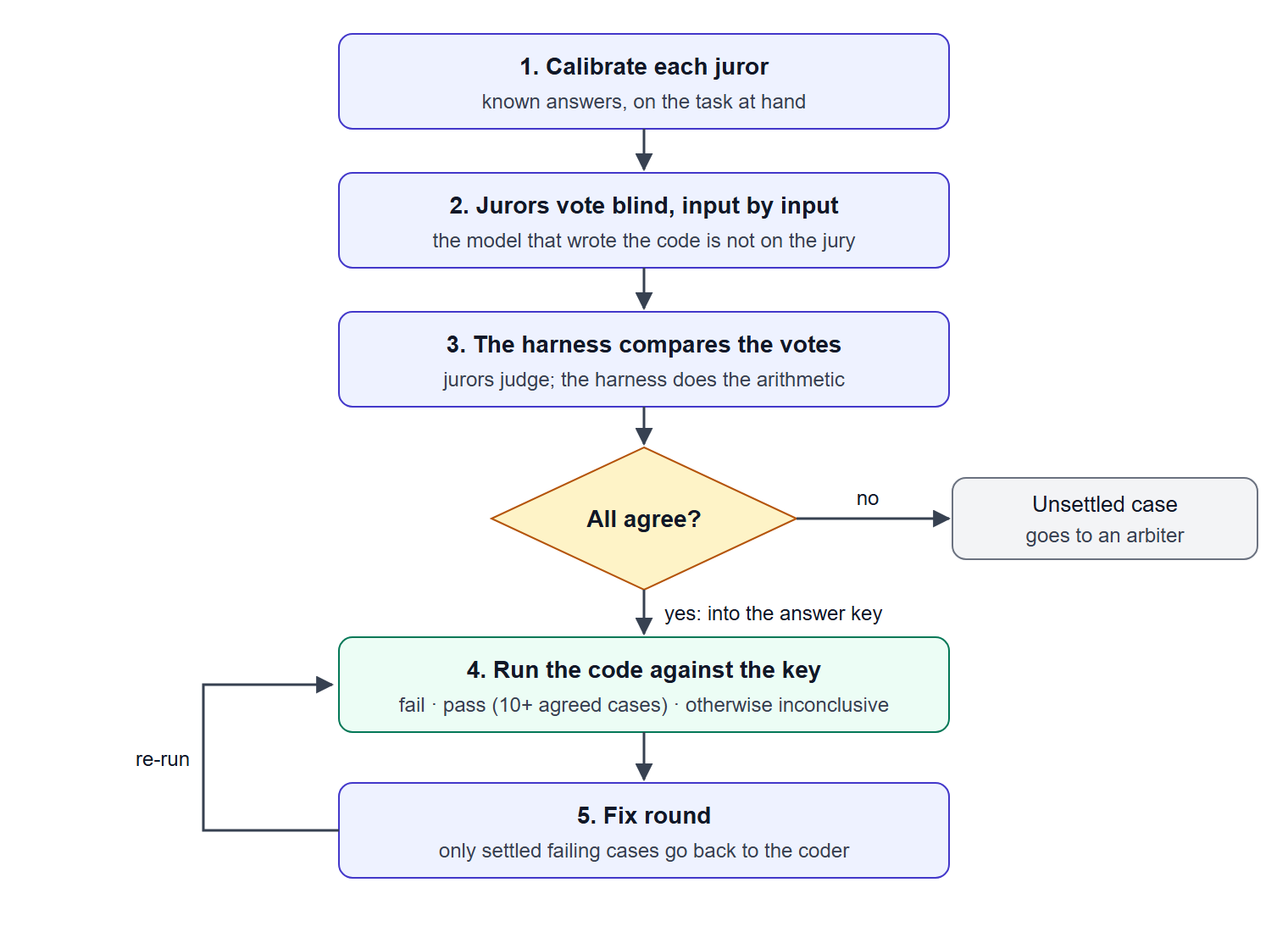
The jury pipeline: five steps, one decision, one loop.
Jurors never judge the code. They vote on the right answer for each input, and the code is run against the answers they agree on. In our runs a disputed case was simply left out; the next step is to send it to an arbiter.
What the first experiment measured
The single reviewer was wrong every time, and the test-backed gate was right every time.
We used two small tasks. Task A parses a duration such as 1h30m into seconds, with strict validation. Task B converts a Roman numeral to an integer, standard form only. For each we wrote a reference implementation and hidden tests that no model ever saw.
| Build | Hidden tests passed after fix rounds | The single model reviewer said | The jury's gate said |
|---|---|---|---|
| Task A, first coder | 16 of 19 | "correct" | fail |
| Task A, second coder | 18 of 19 | "correct" | fail |
| Task B | 27 of 35 | "correctly handles all cases" | fail |
Sharing answers made the jury worse
| On task A, two builds | Shared answers, 2 of 3 adopts | Blind votes, all must agree |
|---|---|---|
| Adopted answers that were correct | 41 of 42, 59 of 64 | 34 of 34, 42 of 42 |
| Real defects found | 10, 5 | 6, 2 |
| False alarms | 0, 5 | 0, 0 |
All five false alarms in the shared version were arithmetic. In two of them the juror that first gave the wrong number corrected itself. The other two jurors had already seen the wrong number, copied it, and outvoted the correction.
Blind voting removed the false alarms but found fewer defects, because one weak juror kept blocking agreement. It cast 30 of the 36 dissenting votes and was never the one who was right. With that juror removed, the blind jury found 6 and 5 defects with no false alarms.
The jury also found four real defects that our own 19 hidden tests had missed, such as accepting 1h30 with no unit on the 30.
Jurors one at a time
Each model answered the same blind questions: 20 calibration questions with known answers, then 114 cases from task A and 34 from task B.
| Juror | Size | Calibration, of 20 | Task A, of 114 | Task B, of 34 |
|---|---|---|---|---|
| Paid model | hosted | 20 | 114 | 34 |
gpt-oss:20b |
13.8 GB | 20 | 114 | 34 |
gemma4:12b |
8.0 GB | 19 | 110 | 34 |
qwen3.5:9b |
6.6 GB | 20 | 112 | not run |
deepseek-r1:14b |
9.0 GB | 19 | 107 | 25 |
llama3.1:8b |
4.9 GB | 16 | 82 | not run |
Passing calibration on one task did not predict accuracy on the next. deepseek-r1:14b scored 19 of 20 on questions drawn from task A, then 25 of 34 on task B, where it accepted IIII, VV and XM as valid numerals.
Juries of two
A case is settled when every juror gives the same answer. The code under test held 24 real defects among the 148 cases.
| Panel | Settled, of 148 | Wrong answers adopted | Defects found, of 24 | False alarms |
|---|---|---|---|---|
| The first pair we seated, both calibrated | 130 | 1 | 19 | 1 |
gpt-oss:20b + gemma4:12b |
144 | 0 | 24 | 0 |
gemma4:12b alone |
148 | 4 | 24 | 4 |
gpt-oss:20b alone |
148 | 0 | 24 | 0 |
| Paid model alone | 148 | 0 | 24 | 0 |
The pairing is what the method buys. Alone, gemma4:12b put four wrong answers in the key. Paired under an all-agree rule, those four became four unsettled cases, which is the safe way to be unsure.
That was not special to this pair. We recomputed every pair we could form from the saved votes. Of 26 pairs, 22 adopted no wrong answer, and together they adopted 5 wrong answers among 1,877 settled. Pairs of models from the same vendor were among the clean ones. That tempted us to conclude that any two jurors who agree will do. The second experiment, below, showed otherwise.
What went wrong along the way
In the first experiment, six bugs in our own harness sat between the models and the numbers, and each one would have changed a result. A harness that checks models is code, and it needs the same checking.
| What we got wrong | What it did | What we changed |
|---|---|---|
| A fixed 300-second limit on local calls | The first run died at exactly 300 seconds: a 109-second cold load, then thinking time | A longer limit, set per engine |
| The mutation tester reused stale compiled files | It reported faults as missed that a hand run caught, so scores read low | Never reuse compiled files between mutants |
| We took the first code block in an answer | We ran a draft the model had already abandoned, which did not compile | Take the last block that parses |
| A failed call counted as a rule violation | An empty answer aborted the whole run | Tell a failure apart from a violation |
| Jurors were asked to add up letter values | XIV scored 16, as X plus I plus V |
Jurors say valid or invalid; the harness computes |
| Test names were looked up in the wrong form | Every label the jury gave was silently dropped | Match on the bare test name |
The models surprised us in three more ways.
- A model reported work it never did. With tools switched off, the paid model wrote "File created successfully" and "178 passed in 0.63 secs". No file existed and nothing had run. Run for real, its file held 146 tests and one failed.
- A thinking model can answer nothing. One fix round ran 254 seconds and returned an empty answer. A retry with thinking off returned code.
- Bad answers leak back in. Our first full run sent the coder four wrong entries from the answer key to "fix".
Then we tested our own conclusion
The first results rested on two tasks and 148 cases, and our re-analysis had produced a bold claim: any two jurors who agree will do. So we tried to break it.
We wrote the thesis and six pass-or-fail lines down before running anything, and named the pair we would be judged by. Then we built the test.
- Ten fresh tasks. Small functions we invented, each with four to six numbered rules, so no model could have seen them before.
- Two independent references. A second implementation, written from the rules alone, agreed with the first on every one of about 964,000 possible inputs.
- Five local jurors, three repeats. Each voted blind on 48 cases per task. Twelve known answers were mixed in, to decide whether a juror was fit to sit for that task.
- Planted faults. Builds with exactly one rule removed, and test suites with known bad tests hidden in them.
| What we predicted | Result | Measured |
|---|---|---|
| The agreement rule keeps wrong answers out | Held | Named pair: 0 wrong of 1,019 settled |
| Juror quality sets how much gets settled | Held | Rank correlation 0.89 across 10 pairs |
| The gate beats a single model reviewer | Held, barely | 98% against 82%, on a 15-point bar |
| A build missing a rule is caught | Held | 92 of 95 |
| Planted bad tests are caught | Failed | Both jurors flagged 28 of 40 |
| Shared mistakes are leniency | Held | 70 of 84 accepted an invalid input |
Every pair in the second experiment. Ten pairs of local jurors, run 25 to 26 November 2026. Only task-rounds where both jurors passed the known-answer check count.
| Pair | Settled cases | Wrong answers adopted | Correct builds the key failed |
|---|---|---|---|
gpt-oss:20b + qwen3.5:9b |
1,110 | 0 (0.0%) | 0 of 48 |
gpt-oss:20b + gemma4:12b (named in advance) |
1,019 | 0 (0.0%) | 0 of 44 |
gpt-oss:20b + deepseek-r1:14b (added after interim results) |
956 | 0 (0.0%) | 0 of 42 |
gpt-oss:20b + phi4 |
642 | 0 (0.0%) | 0 of 30 |
gemma4:12b + qwen3.5:9b |
997 | 10 (1.0%) | 8 of 44 |
deepseek-r1:14b + qwen3.5:9b |
996 | 14 (1.4%) | 12 of 44 |
gemma4:12b + phi4 |
688 | 10 (1.5%) | 8 of 32 |
deepseek-r1:14b + gemma4:12b |
945 | 14 (1.5%) | 12 of 42 |
phi4 + qwen3.5:9b |
657 | 17 (2.6%) | 12 of 30 |
deepseek-r1:14b + phi4 |
601 | 19 (3.2%) | 12 of 28 |
Every pair that included gpt-oss:20b adopted no wrong answer; every pair without it adopted some. Our refutation line, written down before the run, was 2%.
The jury's strength is one juror's strength, guarded. Alone, the strongest juror was wrong on 9 of its 1,440 votes. Paired, none of those nine reached the answer key: they became unsettled cases.
What broke
- "Any two jurors" is wrong. Pairs without the strongest juror put wrong answers in the key, and each of those keys then failed 8 to 12 correct builds.
- Mixing vendors did not rescue them. All five local jurors came from different vendors, so every pair in this experiment was a mixed-vendor pair, and six of the ten still adopted wrong answers.
- The test audit failed because of our own rule. We required both jurors to flag a bad test. The strongest flagged all 40. Its partner flagged 28, so the pair scored 28. A rule built for answers, where disagreement is safe, is the wrong rule for alarms.
- The single reviewer was better than we had said. Across all ten tasks it caught 40 of 44 faulty builds. Its weakness ran the other way: it condemned 4 of 20 correct builds. On the builds used for the head-to-head comparison it caught 28 of 30 and condemned 4 of 14, and a quarter of the failing inputs it named (8 of 32) did not fail. On those same builds the gate caught 29 of 30 and condemned none.
What we had to admit
- Our named pair limped. Its second juror crashed on four in ten first attempts, a fault in the model runner; every crashed call was answered on a later retry. Separately, the pair missed the known-answer bar on every repeat of two tasks, so it was judged on eight tasks, not ten, and on 22 of 30 task-rounds.
- We added a second pair after seeing interim results. We reported it separately, marked as chosen with hindsight. It agreed: 0 wrong of 956.
- One kind of input caused four fifths of all wrong answers. A value wrapped in stray quote characters, which a juror read as the bare value: 67 of the 84. Without those inputs every pair is under 1%, but we ran that check after the fact.
- The harness failed twice more. The scorer overflowed on its first real-sized run, and a replay pass died on a file error. We re-parsed every raw answer to confirm that all 10,264 saved answers matched.
What we concluded
The jury is worth keeping, as a way to build the answer key and sweep for defects. It does not replace running the code. These are the rules we follow after both experiments.
- Tests decide. A model reviewer's verdict is a lead, not a ruling. In the first experiment ours passed three buggy builds. In the second it caught 40 of 44, and also condemned 4 of 20 correct ones.
- A model saying something ran is not evidence either. Run it yourself.
- Jurors vote blind. Shown each other's answers, weaker jurors copy a wrong one and outvote the right one.
- Jurors judge; the harness computes. Every false alarm in our first version, and three of four errors in the third, were arithmetic or grouping left to a model.
- Calibrate on the task at hand. A pass on a different task did not predict accuracy. Known answers mixed into every vote unseated even our strongest juror on 2 of 30 task-rounds.
- Agreement adopts, disagreement goes to an arbiter. With fewer than 10 agreed cases the gate says "inconclusive", never "pass".
- One strong juror, and a second that must agree. Every pair with our strongest juror adopted no wrong answer; every pair without it adopted some. We wrote this rule twice before. The first version was "seat jurors from different vendors". Our data does not show that: same-vendor pairs were clean in the first experiment, and in the second every pair mixed vendors and six still adopted wrong answers. The idea comes from published research, not from us: Verga and colleagues credit their panel's lower bias to disjoint model families, and Kim and colleagues name shared architectures and providers among the causes of correlated errors, while also finding that larger, more accurate models make highly correlated errors even across providers. The second version was "any two jurors who agree", and our second experiment refuted it.
- The author does not sit on its own jury.
- Only settled cases go back to the coder.
- Save every raw answer. Our first full run died on an unparseable answer, and the text was gone. In the second, saved answers let us prove that a crash had lost nothing.
- Write the pass and fail lines down first. Without them, a 70% score against a 75% line reads as close enough, and a one-point pass reads as a clear win. The lines made us call the first a failure and the second marginal.
- Test the harness with jurors whose faults you know. Scripted jurors found a flaw in our case list before any model ran: only 2 to 8 of each task's 48 cases were valid inputs.
The shape this supports: a strong model writes the code and arbitrates disputes, one strong free juror and a second that must agree run the verification sweep blind, and real execution decides.
Where a paid model earns its cost
It earns it as the author, not as a juror. As a juror the paid model scored 148 of 148, and so did the best free one.
As a coder it was the only model whose first drafts passed every hidden test on both tasks. Each local coder passed one task cleanly at best.
| First draft, no fix round | Task A, of 19 | Task B, of 35 |
|---|---|---|
| Paid model | 19 | 35 |
gemma4:12b, thinking off |
14 | 35 |
gpt-oss:20b |
8 | 35 |
phi4 |
19 | 23 |
qwen3.5:9b |
15 | 22 |
A paid model also helped as a tiebreaker. Added as a third vote to our first jury pair, it changed nothing on task A. On task B it took the result from 8 of 10 defects with one false alarm to 10 of 10 with none.
The second experiment agreed. Used as an arbiter there, the paid model was right on all 480 cases, and it would have corrected every one of the 176 wrong answers that any pair adopted.
So the paid seats are the author's and the arbiter's, and the free seats are the jurors'. That lets the expensive model do the work only it does well, while the free ones absorb the repetitive checking.
What we have not shown
The second experiment closed some gaps and left others open.
- The tasks are still small. Twelve tasks in all, each a short text-handling function with a checkable answer for every input. Nothing here says the method works on design, performance or interface work.
- "A strong juror" is one model. Every clean pair contained the same model. We have not shown that another strong model would do as well.
- Truth had one author family. Both reference implementations in the second experiment were written by models from one vendor. They agree on every input, which rules out a slip by one author, not a misreading both share.
- Auditing tests is unsolved. Our pair missed 12 of 40 planted bad tests. Letting either juror raise the alarm would have caught all 40 in hindsight, while wrongly flagging 2 of 80 good tests, but we have not tested that as a rule.
- A jury can still agree and be wrong. Pairs without the strongest juror did so in 1.0% to 3.2% of settled cases, as the research on correlated errors predicts.
- One run, one workstation. The model runner crashed often enough to change which votes counted, and we added a pair after seeing interim results.
The method also fits only work with a checkable right answer for each input. And it is slow: the best free juror took 41 to 82 seconds a vote and needed the whole graphics card, so this is a batch job, not something to wait on.
Protocol and data
We have published the second experiment's protocol, written before the run, together with its data and scoring code: the ten task definitions and both reference implementations, the thresholds, every saved juror answer, and the script that turns them into the tables above. It is at github.com/Netrun-Systems/jury-of-local-models under the MIT licence, and its README lists the commands that reproduce the headline numbers. Scoring needs only Python's standard library; no model is called.
Sources
The arXiv papers, the NASA page and the encyclopedia entry were opened on 24 November 2026 and read at the level of their abstracts or summaries. The Knight and Leveson abstract and the Dalkey and Helmer memorandum were opened on 26 November 2026.
- Zheng et al., Judging LLM-as-a-Judge with MT-Bench and Chatbot Arena, NeurIPS 2023 Datasets and Benchmarks Track
- Verga et al., Replacing Judges with Juries: Evaluating LLM Generations with a Panel of Diverse Models, 2024
- Panickssery, Bowman and Feng, LLM Evaluators Recognize and Favor Their Own Generations, 2024
- Wang et al., Self-Consistency Improves Chain of Thought Reasoning in Language Models, ICLR 2023
- Du et al., Improving Factuality and Reasoning in Language Models through Multiagent Debate, 2023
- Kim et al., Correlated Errors in Large Language Models, ICML 2025
- Laddha, Pradhan and Srivastava, SLMJury: Can Small Language Models Judge as Well as Large Ones?, 2026
- Bi et al., JudgeBoard: Benchmarking and Enhancing Small Language Models for Reasoning Evaluation, 2025
- Tan et al., JudgeBench: A Benchmark for Evaluating LLM-based Judges, ICLR 2025
- Jiang et al., CodeJudgeBench, 2025
- Gu et al., A Survey on LLM-as-a-Judge, 2024, revised 2025
- Chen et al., CodeT: Code Generation with Generated Tests, 2022
- Foster et al., Mutation-Guided LLM-based Test Generation at Meta, 2025
- Knight and Leveson, "An Experimental Evaluation of the Assumption of Independence in Multiversion Programming", IEEE Transactions on Software Engineering 12(1): 96–109, 1986. Abstract read in the copy hosted by KTH, opened 26 November 2026
- Dalkey and Helmer, An Experimental Application of the Delphi Method to the Use of Experts, RAND Memorandum RM-727/1, 1962; published in Management Science, 1963. Introduction read in RAND's copy, opened 26 November 2026
- NASA, IV&V Overview
- Stanford Encyclopedia of Philosophy, Jury Theorems